pyrolib.fuelmap package
Submodules
pyrolib.fuelmap.fuel_database module
Fuel Database utilities
- class pyrolib.fuelmap.fuel_database.FuelDatabase
Bases:
object- dump_database(filename, info, compact=True)
save the current fuel database in a yml file.
- Parameters:
filename (str) – name of the database (database.yml)
info (str) – information about the database
compact (bool, optional) – writting format. Defaults to True.
- load_fuel_database(filename)
load a fuel database in the current fuel database
The database can be search in the package data/fuel_database or locally
- Parameters:
filename (str) – name of the database (database.yml)
pyrolib.fuelmap.fuelmap module
FuelMap file building tools
- class pyrolib.fuelmap.fuelmap.FuelMap(fuel_db: FuelDatabase, namelistname: str = 'EXSEG1.nam', MesoNHversion: str = '5.6.0', workdir: str = '')
Bases:
objectClass for fuel map construction
This FuelMap class allows to create a fuel map object and save it to netcdf format to be an input for a MesoNH-Blaze simulation.
In order to build a fuel map the following file tree is needed:
my_project/
├─ create_my_fuelmap.py
├─ EXSEG1.nam
├─ inifile_MesoNH.des
├─ inifile_MesoNH.nc
The MesoNH namelist EXSEG1.nam is used to retrieved information about fire mesh, fire rate of spread parameterization and MesoNH initialization files. The initialization file (here inifile_MesoNH.nc) is used to get atmopsheric mesh information. The MesoNH file inifile_MesoNH.des will be duplicated to FuelMap.des in order to match MesoNH file reader requirements.
After having set all patches and data treatments to the FuelMap.fuelmaparray, the
write()method can be called to save the file FuelMap.nc. After this operation, the project folder should be:my_project/ ├─ create_my_fuelmap.py ├─ EXSEG1.nam ├─ FuelMap.des ├─ FuelMap.nc ├─ FuelMap2d.nc ├─ inifile_MesoNH.des ├─ inifile_MesoNH.nc
The file FuelMap2d.nc is optionnaly created through the
write()method. It contains the same information that FuelMap.nc but conserves the 2d format of data to be more readable for error checking. It is recommended to use this file to check your set up.- Parameters:
fuel_db (pyrolib.FuelDatabase) – fuel database containing fuel data.
namelistname (str, optional) – MesoNH namelist name (default: ‘EXSEG1.nam’).
MesoNHversion (str, optional) – Version of MesoNH needed (>=5.6.0) (default: ‘5.6.0’)
- add_fuel_line_patch(pos1: tuple, pos2: tuple, fuel_key: str, is_cartesian: bool = True)
Add line patch between (pos1[0], pos2[0]) and (pos1[1], pos2[1]).
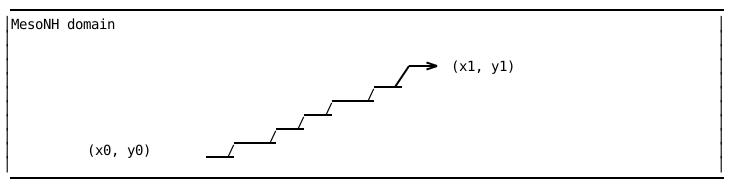
This method first sets the mask corresponding to the following scheme, then assigns the needed data in the appropriated array.
It assigns a fuel type in the masked area through its index. The fuel assigned depends on its index and the selected rate of spread parameterization.
The mask is determined by a bresenham algorithm.
- Parameters:
pos1 (tuple) – Position of west and east boundaries of the patch
pos2 (tuple) – Position of south and north boundaries of the patch
fuel_key (str) – Key of Fuel in fuel database to place in the patch
is_cartesian (bool, optional) – pos1 and pos2 are given with (x, y) instead of (lon, lat) (default: True)
- add_fuel_rectangle_patch(pos1: tuple, pos2: tuple, fuel_key: str, is_cartesian: bool = True)
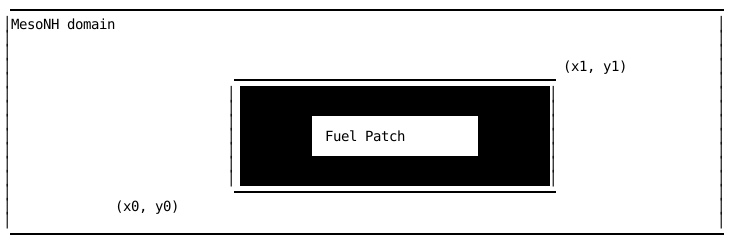
Add rectangle fuel patch between (pos1[0], pos2[0]) and (pos1[1], pos2[1]).
This method first sets the mask corresponding to the following scheme, then assigns the needed data in the appropriated array.
It assigns a fuel type in the masked area through its index. The fuel assigned depends on its index and the selected rate of spread parameterization in the Méso-NH namelist.
- Parameters:
pos1 (tuple) – Position of west and east boundaries of the patch
pos2 (tuple) – Position of south and north boundaries of the patch
fuel_key (str) – key of Fuel in fuel database to place in the patch
is_cartesian (bool, optional) – pos1 and pos2 are given with (x, y) instead of (lon, lat) (default: True)
- add_ignition_line_patch(pos1: tuple, pos2: tuple, ignition_time: float, is_cartesian: bool = True)
Add line patch between (pos1[0], pos2[0]) and (pos1[1], pos2[1]).
This method first sets the mask corresponding to the following scheme, then assigns the needed data in the appropriated array.
It specifies an ignition time for the whole patch.
The mask is determined by a bresenham algorithm.
- Parameters:
pos1 (tuple) – Position of west and east boundaries of the patch
pos2 (tuple) – Position of south and north boundaries of the patch
ignition_time (float) – Ignition time of patch
is_cartesian (bool, optional) – pos1 and pos2 are given with (x, y) instead of (lon, lat) (default: True)
- add_ignition_rectangle_patch(pos1: tuple, pos2: tuple, ignition_time: float, is_cartesian: bool = True)
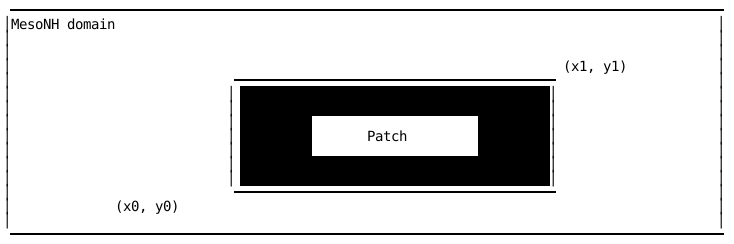
Add rectangle patch between (pos1[0], pos2[0]) and (pos1[1], pos2[1]).
This method first sets the mask corresponding to the following scheme, then assigns the needed data in the appropriated array.
It specifies an ignition time for the whole patch.
- Parameters:
pos1 (tuple) – Position of west and east boundaries of the patch
pos2 (tuple) – Position of south and north boundaries of the patch
ignition_time (float) – Ignition time of patch
is_cartesian (bool, optional) – pos1 and pos2 are given with (x, y) instead of (lon, lat) (default: True)
- add_unburnable_line_patch(pos1: tuple, pos2: tuple, is_cartesian: bool = True)
Add line patch between (pos1[0], pos2[0]) and (pos1[1], pos2[1]).
This method first sets the mask corresponding to the following scheme, then assigns the needed data in the appropriated array.
It Specifies that the patch can not burn (ROS = 0 m s-1 in that area).
The mask is determined by a bresenham algorithm.
- Parameters:
pos1 (tuple) – Position of west and east boundaries of the patch
pos2 (tuple) – Position of south and north boundaries of the patch
is_cartesian (bool, optional) – pos1 and pos2 are given with (x, y) instead of (lon, lat) (default: True)
- add_unburnable_rectangle_patch(pos1: tuple, pos2: tuple, is_cartesian: bool = True)
Add rectangle unburnable patch between (pos1[0], pos2[0]) and (pos1[1], pos2[1]).
This method first sets the mask corresponding to the following scheme, then assigns the needed data in the appropriated array.
It specifies that the patch can not burn (ROS = 0 m s-1 in that area).
- Parameters:
pos1 (tuple) – Position of west and east boundaries of the patch
pos2 (tuple) – Position of south and north boundaries of the patch
is_cartesian (bool, optional) – pos1 and pos2 are given with (x, y) instead of (lon, lat) (default: True)
- add_walking_ignition_line_patch(pos1: tuple, pos2: tuple, walking_ignition_times: list, is_cartesian: bool = True)
Add line patch between (pos1[0], pos2[0]) and (pos1[1], pos2[1]).
This method first sets the mask corresponding to the following scheme, then assigns the needed data in the appropriated array.
- It specifies an ignition time t_a for point A (x0, y0)
and t_b for point B (x1, y1) where t_b > t_a.
The mask is determined by a bresenham algorithm.
- Parameters:
pos1 (tuple) – Position of west and east boundaries of the patch
pos2 (tuple) – Position of south and north boundaries of the patch
walking_ignition_times (list) – Ignition times of points A and B of the ignition line, respectively
is_cartesian (bool, optional) – pos1 and pos2 are given with (x, y) instead of (lon, lat) (default: True)
- dump(verbose: int = 0)
Write 2D Fuel map as netCFD file named FuelMap2d.nc
- Parameters:
verbose (int, optional) – verbose level (0: no prints, 1: low verbosity, 2: high verbosity) (default: 0)
- dump_mesonh(verbose: int = 0)
Write Fuel map as netCFD file named FuelMap.nc for Méso-NH
- Parameters:
verbose (int, optional) – verbose level (0: no prints, 1: low verbosity, 2: high verbosity) (default: 0)
pyrolib.fuelmap.fuels module
Fuel classes
- class pyrolib.fuelmap.fuels.BalbiFuel(**opts)
Bases:
BaseFuelClass of fuel for Balbi rate of spread model [1].
New fuel class is set with default value. Any fuel property can be passed explicitely to the constructor to set a different vaklue than the default one.
- Parameters:
rhod (float, optional) – Dead fuel density (default: 400 kg m-3)
rhol (float, optional) – Living fuel density (default: 400 kg m-3)
Md (float, optional) – Dead fuel moisture (default: 0.1 -)
Ml (float, optional) – Living fuel moisture (default: 1.0 -)
sd (float, optional) – Dead SAV ratio (default: 5000 m-1)
sl (float, optional) – Living SAV ratio (default: 5000 m-1)
e (float, optional) – Fuel height (default: 1.0 m)
sigmad (float, optional) – Dead fuel load (default: 0.95 kg m-2)
sigmal (float, optional) – Living fuel load (default: 0.05 kg m-2)
Ti (float, optional) – Ignition temperature (default: 500 K)
Ta (float, optional) – Air temperature (default: 300 K)
DeltaH (float, optional) – Combustion enthalpy (default: 15.43 MJ kg-1)
cp (float, optional) – Fuel calorific capacity (default: 1912 J K-1 kg-1)
Deltah (float, optional) – Water evaporation enthalpy (default: 2.3 MJ kg-1)
tau0 (float, optional) – Model constant (default: 75590 s m-1)
rhoa (float, optional) – Air density (default: 1.2 kg m-3)
X0 (float, optional) – Fraction of radiant energy (default: 0.3 -)
r00 (float, optional) – Model constant (default: 2.5e-5 -)
LAI (float, optional) – Leaf Area Index (default: 4 -)
cpa (float, optional) – Air calorific capacity (default: 1004 J K-1 kg-1)
stoch (float, optional) – Stochiometry (default: 8.3 -)
wind (float, optional) – Wind at mid-flame (default 0 m s-1)
slope (float, optional) – Slope (default: 0 deg)
References
Examples
>>> import pyrolib.fuels as pyf
>>> # create a new fuel class with default value.
>>> F1 = pyf.BalbiFuel()
>>> # create a new fuel class with default value
>>> # except for `e` and `Md` where a new value is set.
>>> F2 = pyf.BalbiFuel(e=2, Md=0.1)
- copy(**opts)
Copy fuel class to a new fuel class object.
- Parameters:
**opts (optional) – Any valid property can be passed to change its value for the new object
- Return type:
NewFuel as BalbiFuel
Examples
>>> import pyrolib.fuels as pyf
>>> # create a new fuel class with default value.
>>> F1 = pyf.BalbiFuel()
>>> # copy the fuel class with default value
>>> # except for `e` and `Md` where a new value is set.
>>> F2 = F1.copy(e=2, Md=0.1)
- class pyrolib.fuelmap.fuels.BaseFuel
Bases:
ABCAsbtract class for fuel classes.
A fuel class contains every fuel property of a given fuel type. These properties can depend on the rate of spread parameterization used. Therefore, the properties are locally defined for each fuel class type (Balbi, Rothermel, …). The rate of spread corresponding the the physical properties and numerical parameters of the model can be directly computed in the class by
getR(). This method is redefined for each fuel class type.- abstract copy()
- Copy current fuel class.It is possible to change any property of the new fuel class.
- Raises:
NotImplementedError – if not defined in the inherited fuel class.
- copy_from_sequence(sequence, index)
- Copy fuel with changes from given sequence containing properties ensemble.sequence is pandas.DataFrame array with each column corresponding to a property value.The column name shall be the property name.
- Parameters:
sequence (pandas.DataFrame) –
Sequence of properties to modify in the new fuel class.Each column must correspond to a property of the fuel class.index (int) – Index in sequence to use.
- Returns:
NewFuel – New FuelClass with modified properties according to sequence.
- Return type:
same FuelClass as self
- abstract getR()
Compute rate of spread for current fuel.
- Raises:
NotImplementedError – if not defined in the inherited fuel class.
- get_property_vector(fuelindex, nbofproperties)
Construct the array of fuel properties value.
The fuel index is an identifier of the fuel, the following content is the value of each fuel property. Corresponding index in the array is the propertyindex of the
FuelProperty.- Parameters:
fuelindex (int) – Index of fuel to store
nbofproperties (int) – number
- Returns:
out – array of [fuel index, *properties_value]
- Return type:
numpy.ndarray
- minimal_dict(compact: bool)
Construct the minimal dictionnary of the class.
The minimal dictionnay contains the class name (key: class) and the dictionnary of minimal dictionnaries of each
FuelPropertyattributes (key: properties). If compact is True then the dictionnary ofFuelPropertyattributes value are stored instead of minimal dicctionnaries.- Parameters:
compact (bool) – If True, return
- Returns:
out – class name and minimal dictionnaries of class
FuelPropertyattributes.- Return type:
dict
- class pyrolib.fuelmap.fuels.FuelProperty(name, value, unit, description, propertyindex=None)
Bases:
objectRepresents a property for a fuel.
Store property name, description and value.
- name
Short name of the property.
- Type:
str
- value
Value of the property.
- Type:
float
- unit
Unit of the property in SI (International System of Units).
- Type:
str
- description
Short description of the property.
- Type:
str
- propertyindex
Index of the property in fuel type class to be correctly read in MesoNH, default is None. If the propertyindex is None, the property will not be stored in FuelMap file.
Note
It needs to be compliant with the current version of Blaze.
- Type:
int, optional
- minimal_dict()
- Construct the minimal dictionnary of the class.The minimal dictionnay contains the value, the unit and the descrition of the class.
- Returns:
out – dictionnary of value, unit and description
- Return type:
dict
- set(value)
Set value of the property
- Parameters:
value (float) – new value of the property
- pyrolib.fuelmap.fuels.show_fuel_classes(show_fuel_properties=True)
Print fuel classes available in pyrolib and default parameters values
pyrolib.fuelmap.patch module
Patch classes
- class pyrolib.fuelmap.patch.DataPatch(fuelmaparray)
Bases:
ABCAsbtract class for data patch to build fuel map
- Parameters:
fuelmaparray (numpy.ndarray) – Array of acual fuel data (fuel_dim, nyf, nxf)
- abstract getmask()
- class pyrolib.fuelmap.patch.LinePatch(FuelMapArray, xpos, ypos, xfiremesh, yfiremesh, XFIREMESHSIZE)
Bases:
DataPatchClass of a rectangle patch of data for fuel map construction
- Parameters:
fuelmaparray (numpy.ndarray) – Array of acual fuel data (fuel_dim, nyf, nxf)
xpos (tuple) – Position on x axis of boundary points (x0, x1)
ypos (tuple) – Position on y axis of boundary points (y0, y1)
xfiremesh (numpy.ndarray) – Fire mesh on x direction (nxf)
yfiremesh (numpy.ndarray) – Fire mesh on y direction (nyf)
XFIREMESHSIZE (numpy.ndarray) – Array of fire mesh sizes : [dxf, dyf]
- getmask(xfiremesh, yfiremesh, XFIREMESHSIZE)
Compute mask for rectangle patch
Use breseham algorithm to find all point on fire grid between points A (x0, y0) and B (x1, y1).
- Parameters:
xfiremesh (numpy.ndarray) – Fire mesh on x direction (nxf)
yfiremesh (numpy.ndarray) – Fire mesh on y direction (nyf)
XFIREMESHSIZE (numpy.ndarray) – Array of fire mesh sizes : [dxf, dyf]
- class pyrolib.fuelmap.patch.RectanglePatch(fuelmaparray, xpos, ypos, xfiremesh, yfiremesh, XFIREMESHSIZE)
Bases:
DataPatchClass of a rectangle patch of data for fuel map construction
- Parameters:
fuelmaparray (numpy.ndarray) – Array of acual fuel data (fuel_dim, nyf, nxf)
xpos (tuple) – Position on x axis of rectangle corners (x0, x1)
ypos (tuple) – Position on y axis of rectangle corners (y0, y1)
xfiremesh (numpy.ndarray) – Fire mesh on x direction (nxf)
yfiremesh (numpy.ndarray) – Fire mesh on y direction (nyf)
XFIREMESHSIZE (numpy.ndarray) – Array of fire mesh sizes : [dxf, dyf]
- getmask(xfiremesh, yfiremesh, XFIREMESHSIZE)
Compute mask for rectangle patch
- Parameters:
xfiremesh (numpy.ndarray) – Fire mesh on x direction (nxf)
yfiremesh (numpy.ndarray) – Fire mesh on y direction (nyf)
XFIREMESHSIZE (numpy.ndarray) – Array of fire mesh sizes : [dxf, dyf]
pyrolib.fuelmap.utility module
FuelMap utility tools
- pyrolib.fuelmap.utility.convert_lon_lat_to_x_y(confproj: dict, lat: tuple, lon: tuple)
Convert a point (lon, lat) into (x,y)
- Parameters:
confproj – dict conformal projection parameters
lat – tuple latitude position (deg)
lon – tuple longitude position (deg)
- pyrolib.fuelmap.utility.cosd(degrees)
- pyrolib.fuelmap.utility.fill_fuel_array_from_patch(fuelarray, patchmask, propertyvector, np, nx, ny)
Fill fuel array considering a mask
- Parameters:
fuelarray (numpy.ndarray) – Array to modify according to propertyvector and patchmask.
patchmask (numpy.ndarray) – Mask array.
propertyvector (numpy.ndarray) – Vector of properties to fill in the fuel array.
np (int) – Property vector size
nx (int) – Fire mesh size on x axis
ny (int) – Fire mesh size on y axis
- Returns:
fuelarray – Modified array according to propertyvector and patchmask.
- Return type:
numpy.ndarray
- pyrolib.fuelmap.utility.fire_array_2d_to_3d(firearray2d, nx, ny, gammax, gammay)
Reshape 2d fire array into 3d fire array readable by MesoNH
- Parameters:
firearray2d (numpy.ndarray) – 2d array to reshape
nx (int) – Fire mesh size on x axis
ny (int) – Fire mesh size on y axis
gammax (int) – Fire mesh refinement on x axis
gammay (int) – Fire mesh refinement on x axis
- Returns:
firearray3d – Reshaped 3d array
- Return type:
numpy.ndarray
- pyrolib.fuelmap.utility.fire_array_3d_to_2d(firearray3d, nx, ny, gammax, gammay)
Reshape 3d fire array readable by MesoNH to 2d fire array
- Parameters:
firearray3d (numpy.ndarray) – 3d array to reshape
nx (int) – Fire mesh size on x axis
ny (int) – Fire mesh size on y axis
gammax (int) – Fire mesh refinement on x axis
gammay (int) – Fire mesh refinement on x axis
- Returns:
firearray2d – Reshaped 2d array
- Return type:
numpy.ndarray
- pyrolib.fuelmap.utility.njit_wrapper(function)
- pyrolib.fuelmap.utility.sind(degrees)